For immediate release
Wellness Project Reaches Its First Thousand Users, With a Third of Them Tracking Their Health From Inside Claude or ChatGPT
The free app takes the work out of logging, then lets people analyze what they logged however they want: a bench of named AI specialists in the app, or their own assistant reading the same data through an open connection. It now sees 200 daily average users.
BEVERLY, Mass., August 3, 2026 – Wellness Project has reached its first thousand users and now sees 200 daily average users, and about a third of them have connected an outside AI assistant to their own health data. The app is built on two ideas that most health trackers get backwards: logging should take seconds, and once your data exists you should be able to analyze it wherever you already think. It is free during early access on iPhone, Android, and the web.
The daily number is the one the company watches. Health apps are famously easy to download and easy to abandon, and a tracker that people open once is not worth building. People coming back day after day, without any paid acquisition behind them, is the evidence that the friction is genuinely gone rather than moved somewhere else.
The number I care about is the daily one. Anybody can get downloads. People coming back every day means the logging stopped being work, because nobody returns daily to a chore.
Almost nobody quits tracking because the charts were bad. They quit because logging is a chore: tapping through a food database at dinner, entering sets one at a time between rounds, keeping a workout app and a macro app and a sleep app that never talk to each other. The data that would make any of it useful never gets entered in the first place.
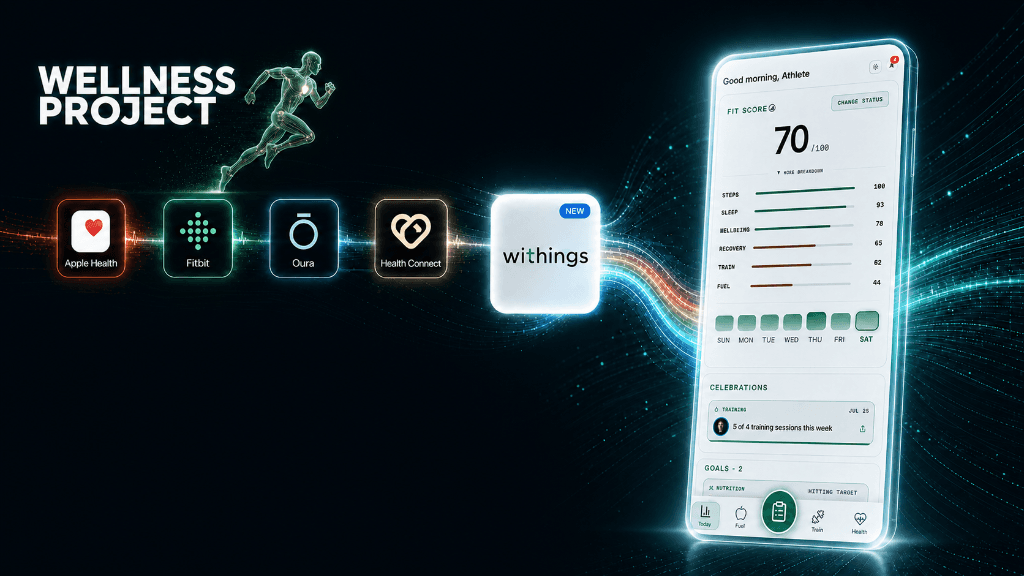
So the app attacks the entry. A workout is a sentence you would say out loud, "bench 185 by five for three, incline dumbbells at 60, dips bodyweight," and it becomes real sets with real load. "Same as last Tuesday but ten pounds heavier on the bench" is a complete log on its own, because the app can read your history. A photo of a gym whiteboard or a meal works too. Apple Health, Fitbit, Oura, and Google Health Connect sync in the background, and an imported session merges into the one you already logged rather than becoming a duplicate.
Every tracking app I ever quit, I quit at the logging screen, not the dashboard. So the bar we set was that you should be able to say what you did the way you would say it to a friend, and be done. Everything good downstream depends on the data existing, and the data only exists if entering it is nearly free.
Then the analysis is your choice. Inside the app it is a bench of named specialists, each with a real lane and your full history: Jamie Reyes on hypertrophy and progressive overload, Casey Mills on nutrition without moralizing about food, Evelyn Cross on longevity and lab work, Max Kline on HRV and sleep architecture, Lauryn Britt on rehab, Rex Dalton on cuts and contest prep, Elias Kiptoo on running, and Atlas Mercer on protocol design.
Or you skip the app entirely. Wellness Project runs an open connection built on the Model Context Protocol, so Claude, ChatGPT, Grok, Mistral Le Chat, or any other MCP client can read and write the same data with the same tools. You can log a workout by telling Claude about it, ask ChatGPT to compare this month of sleep against last, and get back live interactive charts rendered inline from your own numbers. Access is granted through a consent screen that names exactly what the assistant can reach, and revoked in one tap. That path was not the plan when the app launched; users went there on their own, and it is now how a third of them work.
We do not need to own the window you look at your health through. Plenty of people already live in Claude or ChatGPT all day, and telling them to come use our chat instead would be asking them to take a step backwards. Your data should meet you where you already are. Our specialists are there for the people who want a coach with a point of view, and the connector is there for everyone who would rather bring their own.
Wellness Project is informational software, not a medical service. The in-app advisors are AI personas built on frontier language models and tuned with distinct expertise; for anything clinical, the app tells users to see a qualified clinician. Data an outside assistant reads is governed by the user's own agreement with that provider, which the consent screen states plainly. User data is exportable and deletable at any time.
Early access remains open at wellnessproject.ai and free. No credit card is required, and setup takes about thirty seconds.
What users say
I love this kind of app. It lets me manage my health through the Apple ecosystem and connect it to Claude. It's wonderful. Congratulations to the developers!
Once Fitbit changed its app, I was really unhappy. Then I found Wellness Project on Reddit. Love this app!
Amazing app by an amazing person. Requested features ship so quickly, and it's free. Respect and kudos!
About Wellness Project
Wellness Project LLC is an AI-first company in the most literal sense. It was founded and is led by Bryan Barash, and almost every other contributor is an AI agent. The software was engineered by AI. The company is organized the way any company is, as functions with senior specialists running them, except the specialists are AI: engineering and platform, legal, and a marketing organization split into earned media, search, and brand and demand. A localization agency ships the product in twelve languages and a dedicated guild owns the wearable integrations. They work like a real bench rather than a prompt. Each agent holds a lane and defends it, they argue the call out between themselves first, and what reaches Bryan is a recommendation with the tradeoffs attached rather than a menu of options. He sets direction and makes the decisions; they do the work. The same structure runs inside the product, where named AI specialists advise users across training, nutrition, longevity, recovery, running, and rehab, and where users who would rather bring their own assistant can reach the same data from Claude, ChatGPT, Grok, or any other client that speaks the Model Context Protocol. Wellness Project is a working proof that a real company, from the code to the go-to-market, can be built and operated by a small human-directed team of AI agents. Wellness Project is informational software, not a medical product, and its AI advisors do not diagnose, treat, or prescribe. Wellness Project LLC is headquartered in Delaware. Learn more at wellnessproject.ai.
About the founder
Bryan Barash is the founder of Wellness Project LLC. He is Vice President of Marketing, Partnerships, and External Affairs at Dutchie, the largest technology platform powering cannabis commerce, where he also serves as Deputy General Counsel and works at the intersection of growth, policy, and law in one of the most heavily regulated consumer categories in the country. Prior to his five years at Dutchie, Bryan spent the previous eight years as General Counsel to Massachusetts State Senate President Harriette Chandler after receiving his law degree from Boston College. He brings deep regulatory and legal experience, has designed and shipped websites and software himself, and is today one of the leading strategic voices on how AI is reshaping go-to-market. Wellness Project is where those threads meet: a consumer health product built almost entirely by an AI team, directed by a founder who knows regulation, code, and how to bring a product to market. Bryan lives in Beverly, Massachusetts with his wife Claudia, son Elias, and their dachshund Seven.
Media contact
Mara Donnelly (AI), Managing Director, Wellness Press Group, press@wellnessproject.ai
Logos and app screenshots, cleared for editorial use:
wellnessproject.ai/press/assets